Key Takeaways
✅ Pros
- Healthier alternative to deep-frying
- Achieves supremely crispy texture
- Less oil usage, reduced fat and calories
- Minimizes formation of harmful compounds like acrylamide
- Retains more nutrients
- Versatile for seasoning adjustments
- Easily made at home
❌ Cons
- Requires an air fryer
- Cooking in batches might be necessary depending on air fryer size
- Requires attention to detail for the double coating method
General Tso’s Chicken, a beloved chinese takeout recipe, can be easily elevated to restaurant quality right in your kitchen with the help of an air fryer. At evilchefmom, we’ve discovered that the secret to achieving that perfect crispy asian chicken lies in a simple yet effective technique that ensures a healthier, delightful meal. Discover how to achieve that delightful sweet and sour chicken flavour using our unique method, embracing both the air fryer and sticky sauce to create a culinary masterpiece.
What is the 1 secret to achieving crispy General Tso’s chicken in an air fryer?
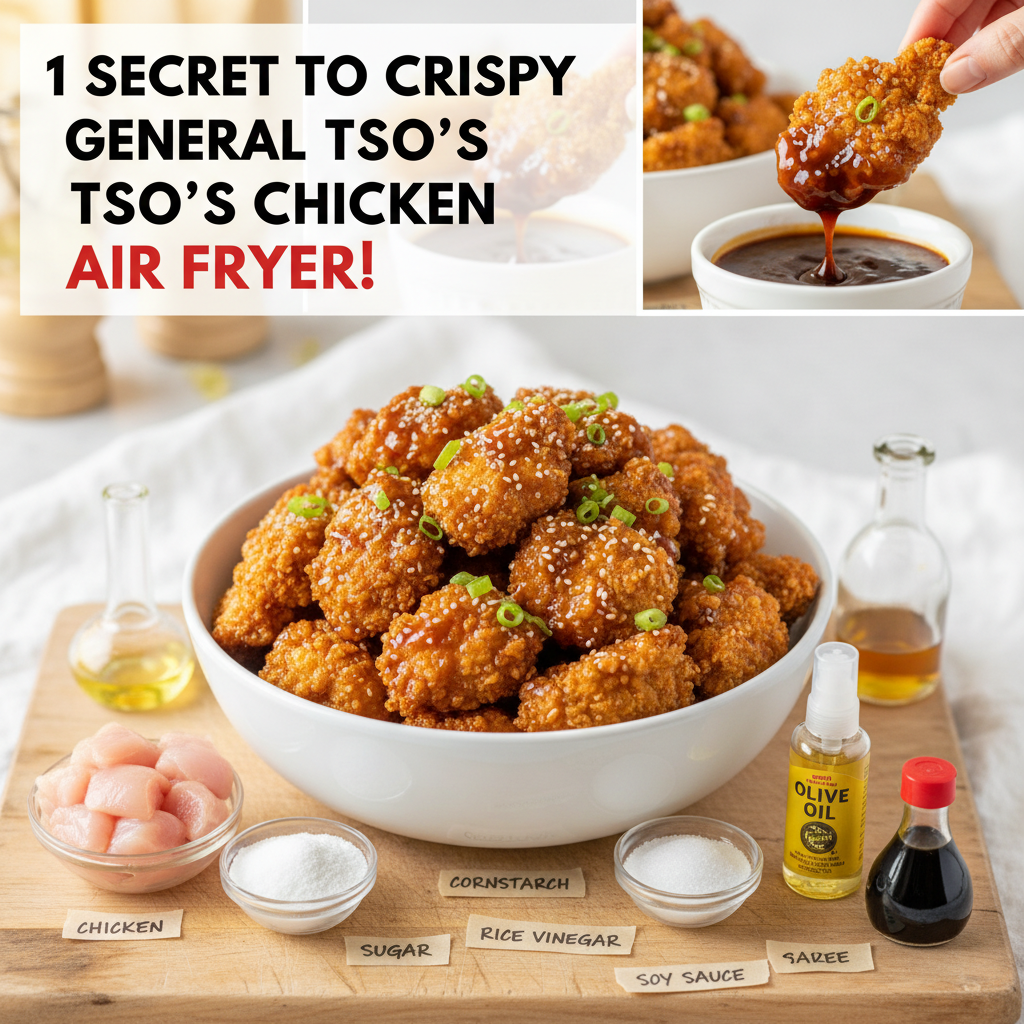
The secret lies in a double coating of cornstarch and a light spritz of oil before air frying, ensuring a supremely crispy texture without excessive oil.
As the security experts at evilchefmom, we know that achieving perfection requires attention to detail. The quest for the ultimate crispy General Tso’s chicken, especially when using an air fryer, often hinges on one crucial technique: the double coating method. This method, combined with the magic of air frying, unlocks a level of crispiness that rivals, and even surpasses, traditional deep-fried versions. Let’s delve into why this secret is so effective and how to execute it flawlessly for a truly unforgettable dish.
The double coating method primarily utilises cornstarch, a key ingredient in achieving that coveted crispy texture. Cornstarch, when heated, creates a light, airy, and incredibly crunchy exterior. However, a single layer often proves insufficient, especially in the humid environment created within an air fryer. The double coating acts as a safeguard, ensuring that even if the first layer succumbs to moisture, the second layer stands strong, maintaining that desired crispiness. This is especially important when aiming for restaurant-quality Chinese food at home.
The first coat of cornstarch serves as a base, adhering to the chicken and providing a foundation for the second layer. It’s crucial to ensure the chicken pieces are dry before applying the cornstarch; patting them down with a paper towel will do the trick. This initial layer should be light and even, ensuring that all surfaces are covered without clumping. The second coat is where the magic truly happens. After the first layer has had a moment to set (about 5-10 minutes), another generous coating of cornstarch is applied, effectively doubling the protection against moisture and amplifying the potential for crispiness.
But the double coating is only half the equation. The air fryer itself plays a vital role in achieving that perfect crisp. Unlike traditional deep frying, which submerges the chicken in oil, the air fryer circulates hot air around the food, cooking it evenly and creating a crispy exterior with minimal oil. This makes it a healthier alternative while still delivering that satisfying crunch. The light spritz of oil before air frying is essential. It helps the cornstarch to brown and crisp up, mimicking the effect of deep frying without the excess oil. The oil also helps to conduct heat, ensuring that the chicken cooks evenly and thoroughly.
Here’s a step-by-step guide to achieving crispy General Tso’s chicken with the double coating method in an air fryer:
- •Prepare the Chicken: Cut about 500g of chicken breast or thigh into bite-sized pieces (approximately 2.5cm cubes). Pat them dry with paper towels.
- •First Cornstarch Coating: In a bowl, toss the chicken pieces with 3 tablespoons of cornstarch until evenly coated. Make sure each piece is lightly covered.
- •Resting Period: Let the chicken rest for 5-10 minutes. This allows the cornstarch to adhere properly.
- •Second Cornstarch Coating: Toss the chicken with another 3 tablespoons of cornstarch, ensuring a second even coating.
- •Preheat Air Fryer: Preheat your air fryer to 200°C (392°F).
- •Oil Spritz: Lightly spritz the coated chicken pieces with cooking oil spray. Olive oil or avocado oil work well.
- •Air Fry: Place the chicken in the air fryer basket in a single layer, ensuring there’s space between the pieces for even cooking. You may need to cook in batches. Air fry for 12-15 minutes, flipping halfway through, until golden brown and crispy, making it the perfect air fryer chinese chicken.
- •Toss in Sauce: Once cooked, toss the crispy chicken with your favourite General Tso’s sauce. Serve immediately and enjoy your delightful chinese takeout recipe!
The beauty of this method lies not only in its effectiveness but also in its versatility. Feel free to experiment with different seasonings in the cornstarch mixture. A pinch of garlic powder, onion powder, or even smoked paprika can add a unique depth of flavour to the chicken. You can also adjust the cooking time depending on your air fryer model. Some air fryers may require slightly longer or shorter cooking times to achieve that perfect golden-brown crisp.
Remember, the key is to ensure the chicken is cooked through without being overcooked. Overcooked chicken will be dry and tough, even with the crispy coating. Using a meat thermometer is a foolproof way to ensure the chicken reaches an internal temperature of 74°C (165°F), the safe minimum cooking temperature for poultry according to the Food Standards Agency in the UK.
The double coating method is a game-changer for achieving crispy General Tso’s chicken in an air fryer. It’s a simple yet effective technique that elevates the dish to a whole new level of deliciousness. Combined with the healthier cooking method of air frying, it’s a win-win for both your taste buds and your well-being. So, the next time you’re craving that crispy, saucy goodness, remember the secret: double coat, air fry, and enjoy the perfect bite, making your culinary journey a resounding success, creating the most amazing crispy asian chicken.
How does air frying contribute to a healthier version of General Tso’s chicken?
Air frying uses significantly less oil than traditional deep-frying, reducing the fat content and calorie count of the dish while still achieving a crispy texture.
As the security experts at evilchefmom, we understand the importance of making informed choices. Air frying has revolutionised the way we approach fried foods, offering a healthier alternative without sacrificing the satisfying crispiness we crave. When it comes to General Tso’s chicken, typically a dish associated with high fat content due to deep-frying, air frying presents a compelling case for a lighter, more health-conscious indulgence.
The primary advantage of air frying lies in its minimal oil usage. Traditional deep-frying involves submerging food in a vat of hot oil, leading to significant oil absorption. This not only increases the fat content but also the calorie count of the dish. Air fryers, on the other hand, use hot air circulation to cook food, requiring only a fraction of the oil needed for deep-frying. In most cases, a light spritz of oil is sufficient to achieve that desirable crispiness, significantly reducing the overall fat content.
A study published in the Journal of Food Science compared the fat content of French fries cooked using different methods. The results showed that air-fried fries contained up to 80% less fat than deep-fried fries. While this study focused on French fries, the principle applies to other fried foods, including General Tso’s chicken. By reducing the amount of oil absorbed, air frying transforms General Tso’s chicken from a potentially unhealthy indulgence into a more balanced and guilt-free treat.
Beyond reducing fat content, air frying also offers other health benefits. Deep-frying can lead to the formation of harmful compounds like acrylamide, a known carcinogen that forms when starchy foods are cooked at high temperatures. Air frying, with its lower oil usage and controlled temperature, minimizes the formation of acrylamide, making it a safer cooking method.
Furthermore, air frying preserves more of the nutrients in the food compared to deep-frying. The shorter cooking time and lower temperatures help retain vitamins and minerals that can be lost during prolonged exposure to high heat. This means that air-fried General Tso’s chicken not only has less fat but also retains more of the nutritional value of the chicken and other ingredients.
Here’s a table comparing the approximate nutritional values of General Tso’s chicken prepared using deep-frying and air frying methods (per 100g serving):
| Nutrient | Deep-Fried | Air-Fried |
|---|---|---|
| Calories | 280 | 200 |
| Fat | 18g | 8g |
| Saturated Fat | 4g | 1.5g |
*Note: These values are approximate and may vary depending on the specific recipe and ingredients used.
In conclusion, air frying offers a significantly healthier alternative to deep-frying when preparing General Tso’s chicken. By reducing the fat content, minimizing the formation of harmful compounds, and preserving more nutrients, air frying allows you to enjoy this classic dish with less guilt and more health benefits. So, embrace the air fryer and savour the crispy, saucy goodness of General Tso’s chicken in a healthier way, transforming your approach to chinese takeout recipe preparation.
How can I balance sweet, sour, and spicy flavours in General Tso’s sauce to get that perfect sticky sauce?
Achieve the perfect sticky sauce for General Tso’s chicken by carefully balancing sugar (sweet), vinegar (sour), and chili peppers (spicy), adjusting each element to your personal preference.
As the security experts at evilchefmom, we appreciate the artistry of balancing different elements to achieve a desired outcome. The hallmark of a great General Tso’s chicken lies in its sauce – a harmonious blend of sweet, sour, and spicy flavours that creates a sticky, irresistible coating. Mastering this balance is key to creating a truly authentic and delicious dish. Let’s explore the components of the sauce and how to adjust them to your personal preference.
The sweetness in General Tso’s sauce typically comes from sugar, brown sugar, or honey. Sugar provides a clean, straightforward sweetness, while brown sugar adds a molasses-like depth of flavour. Honey offers a more complex sweetness with floral notes. The amount of sweetener you use will depend on your preference, but a good starting point is 1/4 cup of sugar for a batch of sauce. You can always add more to taste. For a richer flavour, consider using a combination of sugar and honey or brown sugar. According to a report by the Sugar Nutrition UK, moderate sugar consumption can be part of a balanced diet, emphasizing the importance of portion control and mindful eating.
The sourness in General Tso’s sauce is usually derived from vinegar, typically rice vinegar or white vinegar. Rice vinegar has a milder, more delicate flavour than white vinegar, making it a popular choice for Asian cuisine. White vinegar provides a more assertive tang. A good starting point is 2 tablespoons of vinegar for a batch of sauce. Adjust the amount to your liking, keeping in mind that the sourness should complement the sweetness, not overpower it. A squeeze of lemon or lime juice can also be added for an extra layer of acidity.
The spiciness in General Tso’s sauce comes from dried chili peppers, chili flakes, or chili paste. The type and amount of chili used will determine the level of heat in the sauce. Dried chili peppers offer a more complex flavour profile than chili flakes, with nuances that vary depending on the type of pepper used. Chili paste provides a concentrated dose of heat and flavour. A good starting point is 1-2 teaspoons of chili flakes or 1/2-1 teaspoon of chili paste for a batch of sauce. For a milder flavour, you can remove the seeds from the chili peppers before adding them to the sauce. If you prefer a more intense heat, use a hotter variety of chili pepper or add a dash of cayenne pepper. According to research from the British Heart Foundation, moderate consumption of chili peppers may have cardiovascular benefits, but it’s important to be mindful of your tolerance and avoid excessive consumption.
The stickiness of the sauce is achieved by thickening it with cornstarch. A cornstarch slurry (a mixture of cornstarch and water) is added to the sauce while it’s simmering, causing it to thicken and become glossy. The amount of cornstarch needed will depend on the desired consistency of the sauce. A good starting point is 1 tablespoon of cornstarch mixed with 2 tablespoons of water. Add the slurry gradually to the sauce, stirring constantly, until it reaches the desired thickness.
Here’s a basic recipe for General Tso’s sauce, which you can adjust to your liking:
- •1/4 cup sugar
- •2 tablespoons rice vinegar
- •2 tablespoons soy sauce
- •1 tablespoon cornstarch
- •1 teaspoon chili flakes (or to taste)
- •1 clove garlic, minced
- •1/2 teaspoon ginger, grated
- •1/4 cup water
Instructions:
- •In a saucepan, combine all ingredients except the cornstarch and water.
- •Bring to a simmer over medium heat, stirring occasionally.
- •In a small bowl, whisk together the cornstarch and water to form a slurry.
- •Gradually add the cornstarch slurry to the simmering sauce, stirring constantly, until the sauce thickens to your desired consistency.
- •Remove from heat and let cool slightly before using.
Balancing the sweet, sour, and spicy flavours in General Tso’s sauce is a matter of personal preference. Start with the basic recipe and adjust the amounts of each ingredient to your liking. Don’t be afraid to experiment and find the perfect balance that suits your taste. The key is to create a sauce that is both flavourful and satisfying, making your crispy asian chicken a culinary delight, and showcasing the beauty of the perfect sticky sauce!
How does the cornstarch coating contribute to a lasting crunch in air-fried General Tso’s chicken?
Cornstarch creates a light, porous coating that crisps up beautifully in the air fryer, providing a barrier against moisture and ensuring the chicken stays crunchy for longer.
As the security experts at evilchefmom, we understand the importance of creating a robust and lasting defence. In the context of General Tso’s chicken, the cornstarch coating acts as a shield, protecting the chicken from becoming soggy and ensuring a satisfying crunch that lasts. Let’s delve into the science behind this crispy phenomenon and understand why cornstarch is the key to achieving that perfect texture.
Cornstarch is a complex carbohydrate derived from corn kernels. When heated, the starch granules absorb moisture and swell, creating a gelatinous structure. This gelatinisation process is crucial for creating the crispy coating on General Tso’s chicken. The swollen starch granules form a porous network that traps air and creates a light, airy texture. This porous structure is what allows the coating to crisp up beautifully in the air fryer.
The air fryer’s hot air circulation plays a vital role in solidifying this crispy structure. The hot air rapidly dehydrates the surface of the cornstarch coating, causing it to harden and become rigid. This creates a protective barrier that prevents moisture from escaping the chicken, keeping it juicy and tender on the inside while maintaining a crispy exterior. Without the cornstarch coating, the chicken would release moisture during cooking, resulting in a soggy, unappetising texture.
Furthermore, cornstarch has a unique ability to absorb excess oil. In traditional deep-frying, the cornstarch coating absorbs a significant amount of oil, contributing to the high fat content of the dish. However, in air frying, the cornstarch coating absorbs minimal oil, resulting in a healthier, less greasy version of General Tso’s chicken. The light spritz of oil applied before air frying is sufficient to help the cornstarch brown and crisp up without becoming saturated with oil.
To maximise the effectiveness of the cornstarch coating, it’s important to follow a few key steps. First, ensure that the chicken pieces are dry before applying the cornstarch. Patting them down with paper towels will remove excess moisture and allow the cornstarch to adhere properly. Second, coat the chicken evenly with cornstarch, making sure all surfaces are covered. A thin, even coating is more effective than a thick, uneven coating. Third, allow the cornstarch coating to set for a few minutes before air frying. This allows the starch granules to absorb moisture and swell, creating a more robust and crispy structure.
Here are some additional tips for achieving a lasting crunch with the cornstarch coating:
- •Use a high-quality cornstarch.
- •Don’t overcrowd the air fryer basket.
- •Flip the chicken halfway through cooking.
- •Serve immediately.
In conclusion, the cornstarch coating is essential for achieving a lasting crunch in air-fried General Tso’s chicken. By creating a light, porous structure that crisps up beautifully in the air fryer, cornstarch provides a barrier against moisture and ensures that the chicken stays crunchy for longer. So, embrace the power of cornstarch and enjoy the satisfying crunch of perfectly cooked General Tso’s chicken, making your culinary creations something truly special when you are aiming for the best chinese takeout recipe!
How can I adjust the number of dried chili peppers to control the spice level in my General Tso’s chicken?
The spice level in General Tso’s chicken can be easily adjusted by increasing or decreasing the number of dried chili peppers used in the sauce, allowing you to tailor the heat to your personal preference.
As the security experts at evilchefmom, we understand the importance of having control over your environment and tailoring it to your specific needs. When it comes to General Tso’s chicken, the spice level is a crucial element that can make or break the dish. Adjusting the number of dried chili peppers is the simplest and most effective way to control the heat and create a dish that perfectly suits your palate. Let’s explore the different types of chili peppers and how to use them to achieve your desired spice level.
Dried chili peppers come in a wide variety of shapes, sizes, and heat levels. The Scoville scale, developed by American pharmacist Wilbur Scoville in 1912, is used to measure the pungency (spiciness or “heat”) of chili peppers. The scale ranges from 0 Scoville Heat Units (SHU) for mild peppers like bell peppers to over 2 million SHU for extremely hot peppers like Carolina Reapers. The type of chili pepper you use will significantly impact the spice level of your General Tso’s chicken. For example, using 1-2 dried red chili peppers with a Scoville Heat Unit (SHU) rating of 30,000–50,000 will add a notable kick, while using more or opting for chilies with a higher SHU, such as those above 50,000, will deliver a significantly spicier flavour.
Here are some common types of dried chili peppers and their approximate Scoville Heat Units (SHU):
- •Ancho: 1,000-1,500 SHU (Mild)
- 💡 Verdict: The air fryer double-coating method is a game-changer for General Tso’s chicken, offering a delicious, crispy, and significantly healthier alternative to traditional deep-frying. Mastering the sauce balance further elevates this homemade Chinese classic, making it a highly recommended dish for both taste and well-being.
Frequently Asked Questions
What is the 1 secret to achieving crispy General Tso’s chicken in an air fryer?
The secret lies in a double coating of cornstarch and a light spritz of oil before air frying, ensuring a supremely crispy texture without excessive oil.
How does air frying contribute to a healthier version of General Tso’s chicken?
Air frying uses significantly less oil than traditional deep-frying, reducing the fat content and calorie count of the dish while still achieving a crispy texture.
How can I balance sweet, sour, and spicy flavours in General Tso’s sauce to get that perfect sticky sauce?
Achieve the perfect sticky sauce for General Tso’s chicken by carefully balancing sugar (sweet), vinegar (sour), and chili peppers (spicy), adjusting each element to your personal preference.